

Which Of The Following Is Not An Example Of A Working Drawing To Show How Scenery Is To Be Built?
Production data is '...the data prepared by designers, which is passed to a construction team to enable a projection to be synthetic' (ref. CPIC The importance of product data). Production information is incorporated into tender documentation and then the contract documents for the construction works.
Product information may include:
- Drawings, such as working drawings.
- Specifications.
- Bills of quantities or schedules of work.
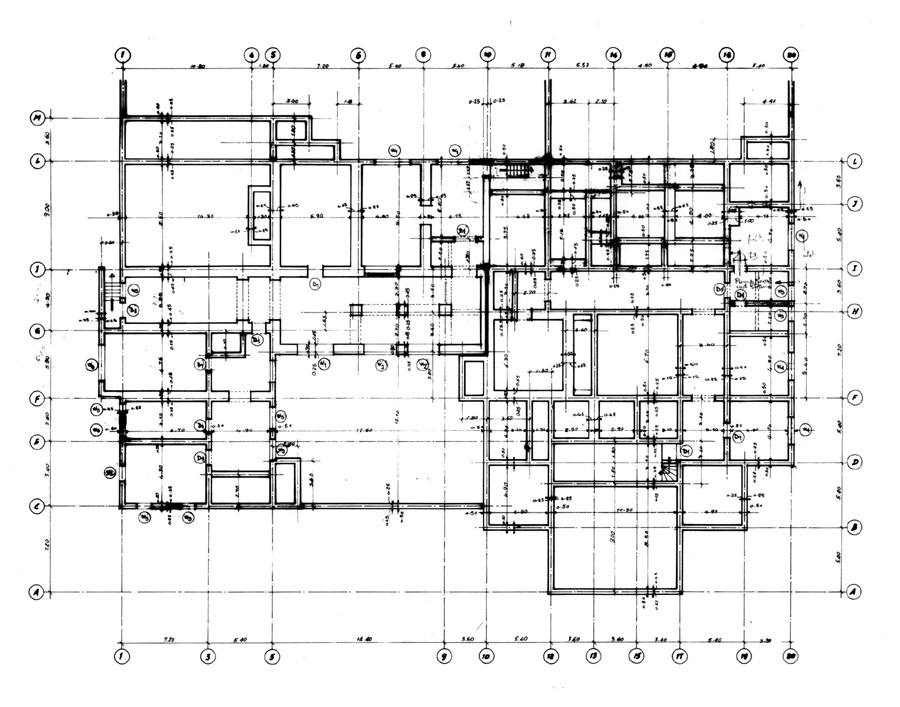
Working drawings provide dimensioned, graphical information that tin can exist used; by a contractor to construct the works, or by suppliers to fabricate components of the works or to gather or install components. They may include architectural drawings, structural drawings, civil drawings, mechanical drawings, electrical drawings, and so on.
Traditionally, working drawings consist of 2-dimensional orthogonal projections of the building or component they are describing, such as plans, sections and elevations. These may be drawn to calibration by mitt, or prepared using Computer Aided Pattern (CAD) software.
Withal, increasingly, edifice information modelling (BIM) is being used to create three-dimensional representations of buildings and their components for construction. This may be described as a virtual construction model (VCM) and can comprise a number of different models prepared by unlike members of the projection team.
Working drawings may include championship blocks, dimensions, notation and symbols. Information technology is important that these are consistent with industry standards so that their precise pregnant is clear and can be understood. Specification information can be included on working drawings or in a split specification, merely information should not exist duplicated every bit this can become contradictory and may cause defoliation.
The scale at which drawings are prepared should reflect the level of detail of the information they are required to convey. Different line thicknesses tin can exist used to provide greater clarity for certain elements.
It is important that the purpose of the drawings and the people that will utilise them are considered. Working drawings might be prepared for; statutory approvals, for contractors to plan the construction works, to provide instructions on site, for the procurement of components, for the preparation of shop drawings, for the appointment of subcontractors then on.
Drawings must be structured carefully so that they convey necessary information to deport out particular parts of the works. To requite greater clarity, they may be separated into packages, so that information is specifically tailored to separate parts of the works, specific components, or separate suppliers or trades.
It may be necessary to produce some packages earlier than others, for example, for items with long manufacturing times such equally switchgear, chiller units, lifts, escalators or bespoke cladding systems, or for front end-end construction such equally service diversions, sabotage, setting out details, secret drainage, piling and groundworks.
The quality of production information is extremely important. Unless it is prepared and co-ordinated properly, there will exist disputes and delays on site, and costs will be incurred. Common problems with working drawings include:
- Poor co-ordination of data.
- Errors and omissions.
- Information not getting to the right people.
- Poor presentation.
Responsibility for the preparation of production information will depend on the selected system of procurement and the chosen form of contract. On traditional contracts (and direction contracts and construction direction contracts), product data may exist produced by a consultant squad, working for the client.
Some specialist elements of production information may exist produced by specialist contractors, co-ordinated by the atomic number 82 designer. On other forms of contract, such as design and build, responsibility for preparing and co-ordinating production data may lie with the main contractor.
Working drawings may be updated when the works are complete to show 'as constructed' data, reflecting changes to the works that may have occurred during the construction process.
Carefully prepared working drawings can be very cute and the very best accept been exhibited equally works of art.
NB Roles in construction projects: assay and terminology, by Hughes, W. and Murdoch, J. R, published in 2001 by the University of Reading, suggests that working drawings is: 'A term that used to exist common but seems to have fallen into disuse, describing information produced by designers for builders.'
[edit] Related manufactures on Designing Buildings
- Equally-built drawings and record drawings.
- Assembly drawing.
- Building data modelling.
- Common mistakes on building drawings.
- Component drawing.
- Computer aided design.
- Concept cartoon.
- Demystifying design processes of architectural details.
- Design drawings.
- Blueprint information.
- Detail drawing.
- Drawings.
- Elevations.
- Engineering cartoon.
- How to draw a floor plan.
- Installation drawings.
- North American Paper Sizes
- Note and symbols.
- Orthogonal plan.
- Packaging.
- Paper sizes.
- Plumbing cartoon.
- Production information.
- Projections.
- Scale drawing.
- Schematic.
- Department cartoon.
- Shop drawings.
- Specification.
- Technical cartoon.
- Technical drawing pen sizes.
- Techniques for cartoon buildings.
- Types of drawing.

Source: https://www.designingbuildings.co.uk/wiki/Working_drawing
Posted by: herediaextre1997.blogspot.com
0 Response to "Which Of The Following Is Not An Example Of A Working Drawing To Show How Scenery Is To Be Built?"
Post a Comment